British India Rupee — Queen Victoria — 1874–1901 One Rupee — Silver .917 — Veiled & Diademed Portrait — “Victoria Empress” Type from 1877
KM#492 (pre-1877 type) · KM#492 / related issues (Empress type) · Silver .917 fine · 30.6–30.8 mm · 11.66 g · ASW approx. 0.3437 troy oz · Calcutta & Bombay Mints
Note: Specific KM numbers and exact mintage figures should be verified against Krause or Pridmore; please treat catalogue references herein as indicative, not definitive.
Pre-Empress Type — 1874–1876
- Title on coin: VICTORIA QUEEN
- Portrait: Veiled and diademed bust, left-facing
- Years struck: 1874, 1875, 1876 (Calcutta and Bombay)
- Reverse: Star and wreath with ONE RUPEE / INDIA
- Mint mark: No mark or incuse “C” = Calcutta · Dot above bottom ornament = Bombay (1874–83)
- Status: Short-run type; replaced when Empress title adopted 1877
Empress Type — 1877–1901
- Title on coin: VICTORIA EMPRESS
- Portrait: Same veiled and diademed bust; legend changed only
- Years struck: 1877–1901 (both mints throughout, with gaps)
- Reverse: Continuous star-and-wreath design; bilingual denomination
- Mint mark: No mark or incuse “C” = Calcutta · Incuse or raised “B” at top = Bombay (from 1883)
- Final year: 1901 — year of Victoria’s death; Edward VII types follow
The Portrait and the Reverse — Continuity Across Twenty-Seven Years
The Victoria rupee of 1874–1901 is a study in deliberate visual conservatism. The obverse presents the Queen in a veiled and diademed portrait facing left — a design derived from William Wyon’s earlier work and adapted for the Indian coinage. The reverse carries a wreath enclosing a central star, with ONE RUPEE / INDIA in English and the Urdu denomination below. Unlike the George V series that followed, this design was not the work of a single named artist commissioned for the purpose; it evolved from the existing Victorian coinage tradition, and the reverse wreath format had predecessors in earlier Indian issues. The relative plainness of the design — compared to Percy Brown’s elaborate Saracenic scroll of 1911 — reflects a different era of colonial coinage philosophy: the coin as a reliable, trusted unit of exchange rather than a decorative imperial statement. Worth verifying: The precise designer credit for the 1874–1901 rupee obverse. William Wyon is associated with earlier Victorian portrait work, but the specific adaptation for this Indian series may involve other Mint engravers. Consult Pridmore for confirmed attribution.
1877 — Victoria Becomes Empress of India
The most significant change across this series is not a design alteration but a legend change. On 1 January 1877, Victoria was proclaimed Empress of India at the Delhi Durbar, under the Royal Titles Act 1876 championed by Prime Minister Benjamin Disraeli. From the 1877 coinage year onward, the rupee’s obverse legend changed from VICTORIA QUEEN to VICTORIA EMPRESS. The portrait itself remained essentially the same veiled and diademed bust. This makes the 1874–1876 issues a short, discrete type of only three years — attractive to type collectors for that reason — while the 1877–1901 Empress type constitutes the main run of nearly a quarter century. The title change was politically significant: it placed Victoria above all European royal peers who held merely royal rank, and aligned her formally with the Mughal imperial tradition in the minds of Indian subjects.
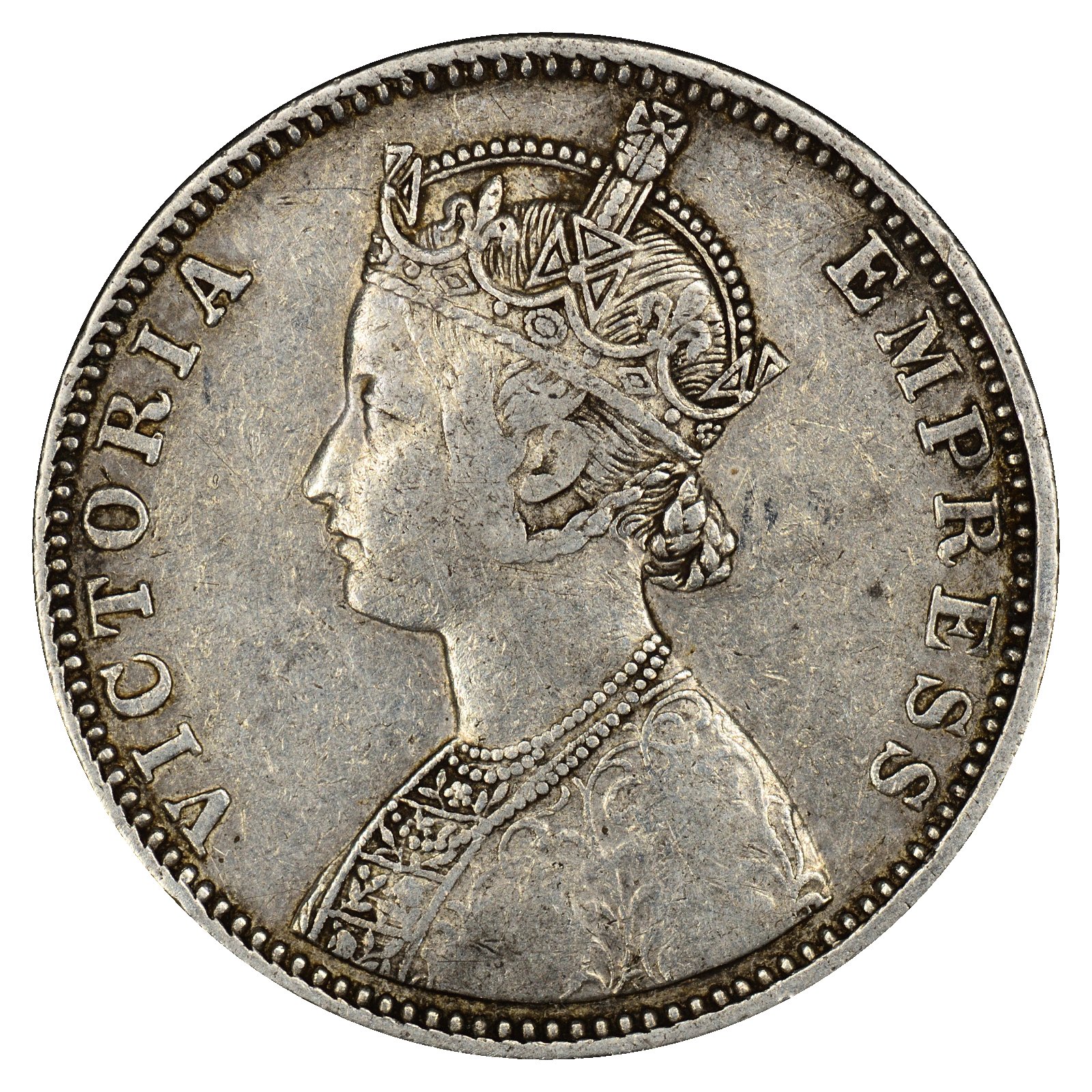
Victoria — veiled & diademed
VICTORIA EMPRESS
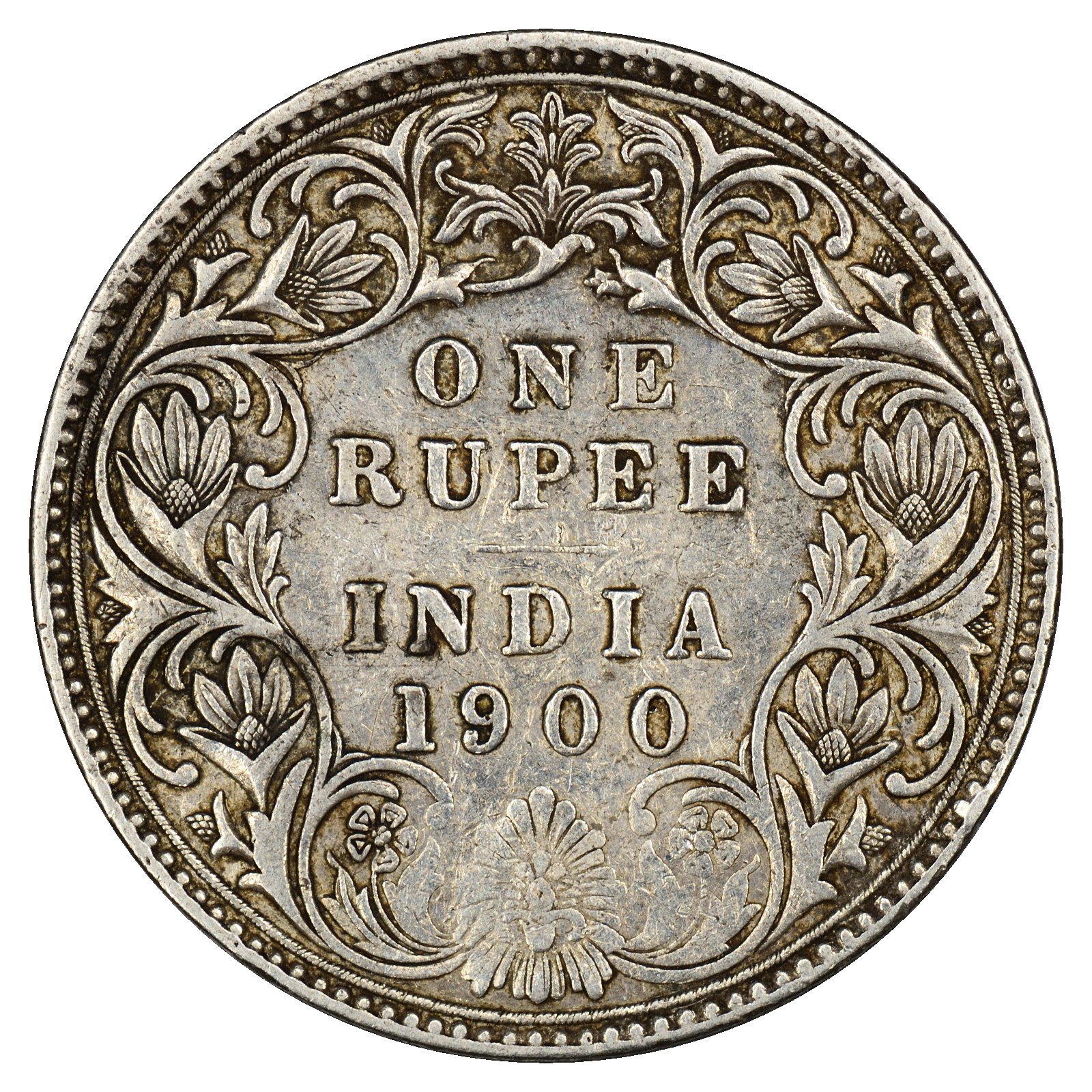
Wreath & star — bilingual
ONE RUPEE / INDIA
| Section | Topic | Notes | |||||||||||||||||||||||||||||||||||||||||||||||||||||||||||||||||||||||||||
|---|---|---|---|---|---|---|---|---|---|---|---|---|---|---|---|---|---|---|---|---|---|---|---|---|---|---|---|---|---|---|---|---|---|---|---|---|---|---|---|---|---|---|---|---|---|---|---|---|---|---|---|---|---|---|---|---|---|---|---|---|---|---|---|---|---|---|---|---|---|---|---|---|---|---|---|---|---|
| History & Context | |||||||||||||||||||||||||||||||||||||||||||||||||||||||||||||||||||||||||||||
| History | The Rupee — Coin of the Raj |
The rupee — worth sixteen annas, sixty-four pice, one hundred and ninety-two pies — was the principal silver denomination of British India and the coin most people across the subcontinent encountered as a unit of significant value. In the 1870s–1890s, one rupee equated approximately to one shilling and four pence sterling, though the exchange rate fluctuated as the global price of silver fell during the latter part of the nineteenth century. For an agricultural labourer, a rupee represented approximately two days’ wages; for a town-dwelling craftsman or clerk, something closer to one day’s. It was the coin that settled land rents, paid wages in cotton mills and railways, purchased sacks of grain at bazaars, and crossed hands at every market from Peshawar to Madras. Its silver content made it universally trusted. 1 Rupee = 16 Annas = 64 Pice = 192 Pies. This old monetary system persisted until Indian decimalisation in 1957. The Victoria rupee was struck throughout the height of this system and carries the bilingual denomination text reflecting the multilingual commercial reality of the Raj. | |||||||||||||||||||||||||||||||||||||||||||||||||||||||||||||||||||||||||||
| History | Queen Victoria — Queen and Empress |
Victoria (24 May 1819 – 22 January 1901) became Queen of the United Kingdom on 20 June 1837 and held that title through the first years of the rupee series examined here. On 1 January 1877 she was proclaimed Empress of India at the Delhi Durbar, a ceremony she did not attend in person. She reigned as Queen-Empress until her death on 22 January 1901 — the last year of this series. Her sixty-three-year reign was the longest of any British monarch to that date. The Indian rupee bearing her portrait circulated across the subcontinent for a generation, and the transition from “Queen” to “Empress” on the coin legend in 1877 is the central collecting distinction of the entire series. Victoria never visited India, despite being its Empress for nearly a quarter century. Her connection to the subcontinent was mediated through correspondence, official reports, and the advice of Indian-born members of her household including Abdul Karim (the Munshi). The coins bearing her portrait were in many cases the primary visual representation of the monarch known to ordinary Indians. | |||||||||||||||||||||||||||||||||||||||||||||||||||||||||||||||||||||||||||
| History | The Silver Crisis — Falling Rupee Value |
One of the defining economic events affecting this series was the sustained fall in the global price of silver during the 1870s–1890s, following the demonetisation of silver by Germany, the United States Coinage Act of 1873, and the consequent shift of major economies toward the gold standard. Because the rupee was a silver coin pegged to a silver weight rather than to sterling, the exchange rate between the rupee and the pound fell sharply: from approximately 1s. 10d. in the early 1870s to around 1s. 2d. or even less by the mid-1890s. This was deeply damaging to the Indian government’s sterling-denominated obligations (interest on public debt, Home Charges paid to London) while simultaneously benefiting Indian exporters. The crisis led to the closure of the Indian mints to free coinage of silver in 1893 — a landmark monetary decision — and ultimately to the adoption of a gold-exchange standard pegging the rupee to sterling at 1s. 4d. in 1899. The 1893 closure of the mints to free silver coinage means that rupee production during 1893–1901 was under direct government control rather than free market supply. This affected mintage figures across the later years of the series. Worth verifying exact mint closure and reopening dates from primary monetary history sources if using for academic purposes. | |||||||||||||||||||||||||||||||||||||||||||||||||||||||||||||||||||||||||||
| The 1877 Empress Change | |||||||||||||||||||||||||||||||||||||||||||||||||||||||||||||||||||||||||||||
| 1877 | Royal Titles Act 1876 — What Changed and Why |
The Royal Titles Act 1876, passed through Parliament largely at the initiative of Prime Minister Benjamin Disraeli, authorised Victoria to assume the additional title of Empress of India. The political rationale was multi-layered: it was intended to elevate the Queen above continental European monarchs (Kaiser Wilhelm I of Germany, Tsar Alexander II of Russia) who were mere Emperors of their own states but not her equals in terms of imperial domain; it was also designed to align the British sovereign with the Mughal imperial tradition in Indian eyes, giving the Crown an explicitly imperial legitimacy in the subcontinent. The proclamation ceremony took place at Delhi on 1 January 1877. The rupee coinage was updated for that year’s production, changing the obverse legend from VICTORIA QUEEN to VICTORIA EMPRESS. No change was made to the portrait or the reverse. The title change was not universally popular in Britain. The opposition Liberal party, led by Gladstone, objected to what they saw as a theatrical adoption of an oriental despotic title. The debate in Parliament was sharp. On the coins themselves, however, the change is straightforward and clean: the portrait is the same, only the two words of the legend differ. | |||||||||||||||||||||||||||||||||||||||||||||||||||||||||||||||||||||||||||
| 1877 | Distinguishing the Two Legend Types |
Attribution is straightforward and requires no magnification at Fine or above:
Pre-Empress (1874–1876): Legend reads VICTORIA QUEEN. Three years only. Both mints. Short type of genuine collector interest because of its brevity. Empress type (1877–1901): Legend reads VICTORIA EMPRESS. Twenty-five years. Both mints throughout, with some years from one mint only. The main series. There is no ambiguity between the two types: the words QUEEN and EMPRESS are fully legible on any coin above Fair condition. Unlike the George V “Pig Rupee” distinction (which requires a loupe to examine the elephant), type attribution here is immediate. |
|||||||||||||||||||||||||||||||||||||||||||||||||||||||||||||||||||||||||||
| Design — Both Types | |||||||||||||||||||||||||||||||||||||||||||||||||||||||||||||||||||||||||||||
| Design | Obverse | The obverse presents a left-facing veiled and diademed bust of Victoria. The Queen is shown in later-life portrait with a widow’s veil — she had worn mourning dress following the death of Prince Albert in 1861 and maintained it for the remainder of her life. The diadem (a small crown or tiara worn at the forehead rather than a full coronation crown) is the distinctive feature of the portrait. The legend reads VICTORIA QUEEN (1874–1876) or VICTORIA EMPRESS (1877–1901) running around the circumference. Worth verifying: Whether the same die portrait was used continuously from 1874 to 1901 or whether any obverse die revision occurred mid-series. Victorian Indian coinage sometimes saw incremental portrait adjustments not always well-documented in standard catalogues. Pridmore’s study is the recommended reference for die-variety detail. | |||||||||||||||||||||||||||||||||||||||||||||||||||||||||||||||||||||||||||
| Design | Reverse — Star and Wreath |
The reverse of the Victoria rupee is markedly different from the Saracenic arabesque scroll that Percy Brown would design for the George V series in 1911. It is a simpler, more conventional Victorian wreath design: a circular laurel (or lotus-and-floral) wreath enclosing a central device, with ONE RUPEE and INDIA in English and the Urdu denomination below. A star appears as a central or prominent reverse element. The overall composition is consistent with British colonial silver coinage design conventions of the 1860s–1890s — dignified, clear, and functional rather than architecturally inventive. I am not fully certain of the precise botanical species represented in the wreath (laurel vs. a hybrid of Indian florals) without confirming against a high-resolution reference image. Numista and Krause catalogue photographs would clarify this. The description above reflects the general character of the design type. | |||||||||||||||||||||||||||||||||||||||||||||||||||||||||||||||||||||||||||
| Design | The Edge and Bilingual Legend |
The edge is reeded throughout the series. The reverse carries a bilingual denomination: ONE RUPEE and INDIA in English with Urdu script below addressing the majority non-English-reading population. This bilingual format was a continuous convention of British Indian silver coinage. The date appears at the foot of the reverse in all years. No edge inscription was used — the reeding is functional and anti-counterfeiting only. | |||||||||||||||||||||||||||||||||||||||||||||||||||||||||||||||||||||||||||
| Mints & Production | |||||||||||||||||||||||||||||||||||||||||||||||||||||||||||||||||||||||||||||
| Mint | The Calcutta Mint — No Mark or Incuse “C” |
The Calcutta Mint (Strand Road, Calcutta — now Kolkata) is identified on the 1874–1901 rupee series by either no mint mark at all, or by a small incuse (indented) letter “C” on the ornamental figure at the bottom of the reverse (6 o’clock position). The incuse “C” can appear as merely a tiny circle on worn examples and requires care to distinguish from a die flaw. A 10× loupe under strong directional light is recommended. Note also that some Calcutta coins from 1877–1880 appear to have used a dot as well, which can complicate attribution of dot-bearing coins from those years. Important correction from the George V convention: on George V rupees (1911–1922), Calcutta is identified solely by the absence of a mark. On the Victoria series, a positive incuse “C” may also appear. Always check the 6 o’clock ornamental figure on Victoria rupees — do not rely on absence alone. Source: J. Franklin Campbell, The Coins of British India, jfcampbell.us. | |||||||||||||||||||||||||||||||||||||||||||||||||||||||||||||||||||||||||||
| Mint | The Bombay Mint — Dot (1874–1883) then “B” (1883–1901) |
The Bombay Mint identification changed during this series and must be treated in two distinct periods:
1874–1883 (Dot period): Bombay is identified by a dot mint mark, normally just above the ornamental figure at the bottom of the coin. An 1879 variety places the dot inside the rosette instead. Note that some Calcutta coins from 1877–1880 also appear to carry a dot, so a dot alone is not conclusive for Bombay attribution in those years. 1883 (Transition year): Three varieties are known — dot only, raised “B” only, and dot plus raised “B” together. 1883–1901 (“B” period): Bombay is identified by either an incuse “B” or a raised “B”, normally on the flower-like ornamental figure at the top of the coin (12 o’clock position). Exception: the 1884 rupee has the raised “B” on the whorl at the bottom. The incuse “B” is sometimes inverted (upside down) — known examples include 1887 and 1888. The raised “B” is particularly prone to appearing as an indistinct bump due to wear, damage, or poor striking. All mint marks on this series are on the reverse and are often small and subtle. Strong directional lighting and a magnifier are essential for reliable attribution. The raised “B” in particular can be very difficult to confirm on circulated examples. Do not pay a Bombay premium without personally verifying the mark. Source: J. Franklin Campbell, The Coins of British India, jfcampbell.us. |
|||||||||||||||||||||||||||||||||||||||||||||||||||||||||||||||||||||||||||
| Mint | The Madras Mint — 1862 Only (not in this series) |
The Madras Mint closed in 1867 and falls entirely outside the 1874–1901 scope of this guide. It is noted here for completeness: Madras-attributed rupees are confined to certain 1862-dated issues (the 1862 B/II 0/0 and 1862 B/IIa 0/0 varieties). No Madras rupees exist for any date within this series. Source: J. Franklin Campbell, The Coins of British India, jfcampbell.us. | |||||||||||||||||||||||||||||||||||||||||||||||||||||||||||||||||||||||||||
| Mint | Date Survey 1874–1901 |
|
|||||||||||||||||||||||||||||||||||||||||||||||||||||||||||||||||||||||||||
| Valuation | |||||||||||||||||||||||||||||||||||||||||||||||||||||||||||||||||||||||||||||
| Value | Empress Type — Common Date Price Guide |
|
|||||||||||||||||||||||||||||||||||||||||||||||||||||||||||||||||||||||||||
| Value | Pre-Empress “Queen” Type 1874–1876 Premium |
|
|||||||||||||||||||||||||||||||||||||||||||||||||||||||||||||||||||||||||||
| Value | Silver Content vs Numismatic Value |
Each Victoria rupee contains approximately 10.69 g of pure silver (approximately 0.3437 troy oz) — identical to the George V rupee that followed, as the .917 standard was maintained. At approximately $75/oz silver, the bullion floor is approximately $25.78. Common Empress-type dates in Fine or VF therefore sit just modestly above bullion value, while EF and UNC examples carry a 2–5× numismatic premium. The pre-Empress “Queen” type and the final 1901 date carry additional type or date premiums on top. The consistent silver content across the entire 1874–1901 series means that even heavily worn examples should not be acquired below bullion value. Verify current silver spot price before any purchase; ~$75/oz is used here as an approximate reference only. | |||||||||||||||||||||||||||||||||||||||||||||||||||||||||||||||||||||||||||
| Collecting Notes | |||||||||||||||||||||||||||||||||||||||||||||||||||||||||||||||||||||||||||||
| Collect | Type Set or Date Set? |
For most collectors, the choice is between a two-coin type set and a more comprehensive run. A type set — one “Victoria Queen” (1874–76) and one “Victoria Empress” (any common date, 1877–1901) in VF — tells the complete story of the series in two pieces at modest cost. The natural expansion is a date set by decade: one coin per decade (1870s, 1880s, 1890s, 1901) covering the arc of the reign. A full year-by-year run of all 27+ date-mint combinations is a specialist undertaking requiring careful sourcing, particularly for years where one mint may not have struck rupees. Start with the type set; build from there. | |||||||||||||||||||||||||||||||||||||||||||||||||||||||||||||||||||||||||||
| Collect | What to Look For | Key grading points: (1) The Queen’s veil — the fabric folds across the crown of the head; first point to flatten with wear. (2) The diadem — small ornamental band across the forehead; fine detail lost early. (3) The hair behind the diadem — should show strand definition in VF. (4) The wreath on the reverse — individual leaf tips and berry detail should be defined in EF and above. (5) The inner legend and date — should be crisp and fully separated from the fields. (6) The Bombay dot — confirm with 10× loupe under raking light; raised and circular if present. (7) The legend words QUEEN vs EMPRESS — always read this at the outset; type attribution is immediate at Fine and above. | |||||||||||||||||||||||||||||||||||||||||||||||||||||||||||||||||||||||||||
| Collect | Problems to Avoid | (1) Cleaning and polishing — extremely common in Indian silver coinage; a buffed coin loses its die-flow lustre and shows unnatural brightness without cartwheel. (2) Misread type — always confirm “Queen” vs “Empress” before paying a type premium. (3) Lost Bombay dot — on worn coins the dot may be gone; do not assume Bombay without confirming it. (4) Over-grading — the reverse wreath can retain sharp detail longer than the obverse portrait; always grade by the weaker (obverse) side. (5) Banker’s marks and test cuts — Victoria rupees from circulation frequently carry small punched or incised marks from bazaar and treasury use; these reduce collector value and should be disclosed. | |||||||||||||||||||||||||||||||||||||||||||||||||||||||||||||||||||||||||||
| Collect | Collection Contexts | The Victoria rupee fits naturally into: a British India rupee type set by monarch (Victoria, Edward VII, George V, George VI — four types, four coins); a Victorian Empire silver set alongside other Victoria-portrait silver coins from the wider Empire; a silver crisis monetary history set with documents of the 1893 mint closure as context; a Indian rupee series set running from the earlier uniform-design issues of the 1860s through to Independence in 1947; or a portrait progression set showing the evolution of Victoria’s numismatic portraits from the young queen (1840s) through the widow empress (1874–1901). | |||||||||||||||||||||||||||||||||||||||||||||||||||||||||||||||||||||||||||
| Collect | Related Coins | Natural companions: the Victoria half rupee 1874–1901 (smaller module; same design family; also carries the “Queen”/“Empress” type distinction); the Victoria quarter rupee (same series in smaller denomination); the Edward VII rupee 1903–1910 (KM#508 — direct successor; uncrowned portrait, different reverse design); the earlier Victoria rupee issues of the 1860s–early 1870s (a different portrait type — worth verifying the exact design transition date preceding this series); and the George V rupee 1911–1922 (the next major series change, introducing the Saracenic scroll reverse and the celebrated “Pig Rupee” controversy of 1911). | |||||||||||||||||||||||||||||||||||||||||||||||||||||||||||||||||||||||||||
Sources and verification notes: Krause Standard Catalog of World Coins — KM# numbers for Victoria India rupee series (verify exact KM references against current edition) · Pridmore, F. The Coins of the British Commonwealth of Nations, Part IV: India — primary reference for die descriptions, mintage data, and Bombay dot attribution · Chakravarty, D. — mint identification conventions · Numista catalogue — community valuations and die photos · Heritage Auctions and Stack’s Bowers Galleries — realised price reference · Silver spot price reference: ~$75/oz USD (verify current price before use) · Important: Specific mintage figures, exact KM catalogue numbers, and per-year mint production data have not been independently verified for this guide. All such figures should be confirmed against Pridmore and the current edition of Krause before being cited or relied upon.